
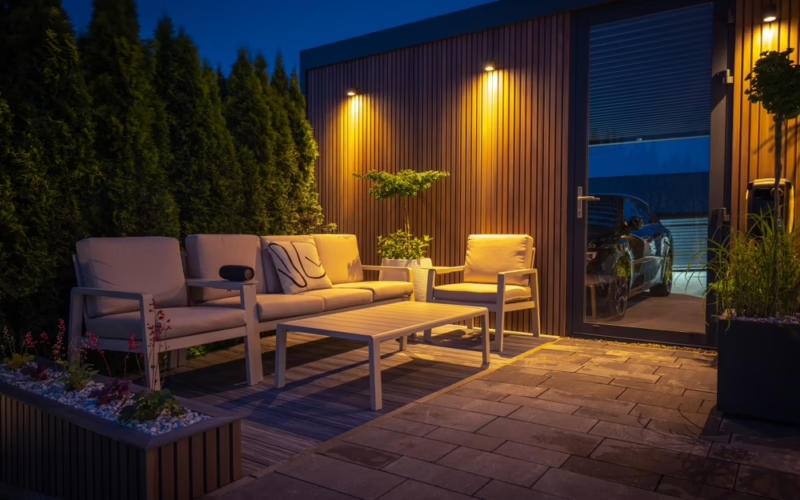
Good outdoor lighting does three jobs at once: it keeps steps and walkways usable after dark, it makes a property less appealing to anyone poking around at night, and it gives the house a finished look from the curb. The technology has changed quickly, and nearly every fixture sold today is LED, which cut the running cost of a full landscape system to a few dollars a month. What has not changed is the planning, and that is where most do-it-yourself lighting projects go wrong. Working with experienced local professionals, such as the team at GB Electric, makes sure that your system is planned for long-term safety and maximum visual impact.
Layering Beats Brightness Every Time
The most common mistake is one very bright floodlight bolted above the garage, pointed at everything. It creates harsh glare, deep shadows beside it, and a security blind spot right where someone would stand. Designers and electricians from GB Electric solve this by splitting the exterior into layers and lighting each one at a modest level:
- Ambient layer: Soft, broad light across the facade and yard, usually from wall washes, downlights mounted in soffits, or moonlighting fixtures set high in mature trees.
- Task layer: The practical light on stairs, walkways, driveways, grill areas, and door locks, typically path lights and recessed step lights at 50 to 150 lumens each.
- Accent layer: Uplights and well lights aimed at stone columns, specimen trees, water features, or textured brick, adding depth once the first two layers are set.
A house lit in layers usually uses more fixtures but less total wattage, and the result looks intentional rather than institutional.
Low-Voltage Systems Versus 120-Volt Fixtures
Almost all landscape lighting installed now runs at 12 volts through a transformer, while fixtures attached to the building (sconces, soffit lights, floodlights) usually run on standard 120-volt circuits. Each has a place.
Low-voltage cable can sit six inches deep per NEC burial rules, is safe to handle, and lets you add or move fixtures later without tearing up the yard. The catch is voltage drop: long runs on undersized wire leave the last fixtures dim, so a good installer sizes the cable (often 12 or 10 gauge) and splits the load across multiple taps on the transformer.
Line-voltage fixtures deliver more output over longer distances and are the right answer for driveway poles, barn lights, and security floods. They also require conduit or direct-burial cable at 18 inches, GFCI protection, and wet-location-rated enclosures, which is why line-voltage work belongs to a licensed contractor like GB Electric rather than a weekend DIY project.
Color Temperature Makes or Breaks the Look
Kelvin rating controls whether a house looks warm and residential or like a parking lot. For most homes, 2700K to 3000K flatters brick, wood, stucco, and skin tones, and it matches the interior light spilling through windows.
Push past 4000K and the light reads blue-white, which some homeowners prefer for driveways and detached garages because it feels brighter at the same lumen level. The important rule is consistency: mixing 2700K path lights with 5000K floodlights on the same elevation looks like a mistake from the street. Tunable fixtures that let you select the Kelvin on the fixture itself are now standard on better product lines and solve the matching problem.
Brightness deserves the same restraint. A path light rarely needs more than 100 lumens, a wall sconce 400 to 800, and a tree uplight 300 to 600 depending on canopy height. The U.S. Department of Energy notes that LEDs use at least 75 percent less energy than incandescent lighting and last far longer, which is why running a dozen small fixtures now costs less than running two old halogen floods.
Controls Homeowners Actually Use
Timers fail because seasons shift. An astronomic timer or a smart transformer tracks sunset and sunrise by date and location, so the system turns on at dusk in June and in December without anyone touching it. Installers frequently pair that with one of the following setups:
- Photocell plus timer: On at dark, off at a set hour such as 11 p.m., the simplest reliable setup.
- Motion sensors on security zones only: Keeps flood output off until something moves, which is friendlier to neighbors than all-night glare.
- App or hub control: Wi-Fi or Bluetooth transformers that allow scenes, zone dimming, and holiday color on RGBW fixtures.
- Dimmers on line-voltage fixtures: LED-compatible models only, since standard dimmers cause flicker and buzz.
Dimming is underrated. Running accent lighting at 60 percent often looks better than full output and stretches driver life.
Code, Ratings, and Light Trespass
Outdoor fixtures must be rated for their location: damp-rated under a covered porch, wet-rated anywhere exposed to rain or sprinklers. Receptacles outdoors need GFCI protection, and in-use (bubble) covers are required where a cord stays plugged in. Transformers should be mounted at least 12 inches above grade and fed from a GFCI-protected circuit.
Aiming matters for neighbors and for the sky. Shielded, downward-facing fixtures cut glare and keep light on your property, an approach the International Dark-Sky Association has pushed for decades and that many townships now write into ordinance. Electricians installing outdoor lighting in Allentown, PA, including the team at GB Electric, routinely add glare shields and hex louvers to uplights for exactly this reason.
What a Real Outdoor Lighting Project Costs
Pricing varies with fixture quality and trenching difficulty, but typical installed figures look like this:
- Low-voltage landscape system, 8 to 12 fixtures: Roughly $2,500 to $6,500 installed, including transformer, cable, and aiming.
- Per-fixture add-ons later: About $150 to $400 each depending on run length.
- Replacing two exterior wall sconces: Commonly $200 to $450 in labor when wiring already exists.
- New 120-volt circuit or driveway post light: Often $600 to $1,800 with trenching.
Brass and copper fixtures cost two to three times more than cast aluminum but survive coastal air, road salt, and string trimmers, and many carry lifetime housing warranties. Composite and plastic bodies are fine for short-term budgets, less so for a twenty-year install. Contractors handling outdoor lighting in Bethlehem, PA see far more failures from cheap wire connectors than from the fixtures themselves, so ask what splice method your electrician uses; silicone-filled or heat-shrink connectors are the standard worth paying for.
Keeping a System Looking New
LED fixtures are low maintenance, not no maintenance. Once a year, trim back the plants that have grown over uplights, wipe mineral film off lenses, re-aim anything knocked loose by mowing, and check the transformer for insect nests. Mulch piles higher each spring and slowly buries well lights, which traps heat and shortens driver life. Fixtures with replaceable LED modules or standard MR16 lamps let you swap a single failed component instead of the entire housing, a detail worth asking about before purchase.
Talk Through Your Exterior Lighting Plan With a Licensed Electrician
If you are weighing fixture placement, voltage, or controls for your property, contact us today for a short site walkthrough with an electrician will tell you what the existing wiring can support and what the layout should look like. GB Electric handles exterior lighting design, transformer sizing, and complete installation for residential properties across the Lehigh Valley.
