
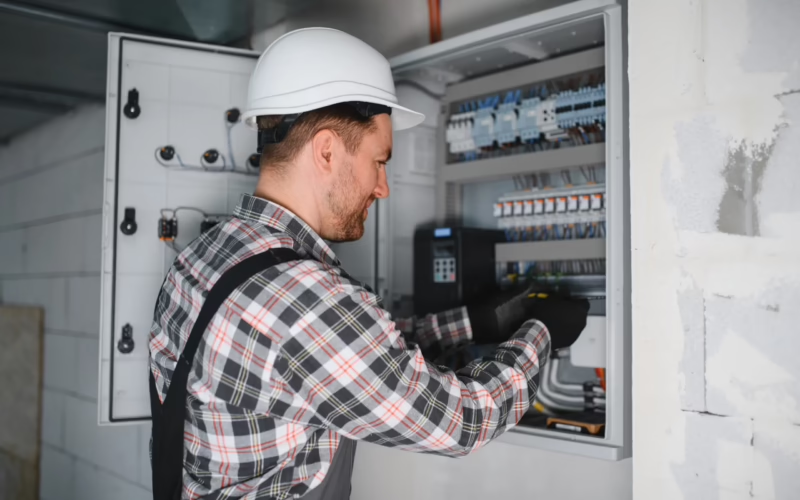
A panel installed in 1978 was sized for a stove, a furnace, and a window air conditioner. Today that same box is feeding a heat pump, an induction range, a hot tub, and maybe an EV charger in the garage, which is exactly why electric panel replacement has become one of the most common upgrades in older regional homes. At GB Electric, we see how an aging panel becomes the hidden bottleneck for modern home improvements. The warning signs usually show up months before anything fails outright, and most of them are easy to spot from your basement or garage wall.
Electrical distribution and lighting equipment is involved in roughly 46,700 reported home structure fires each year, according to NFPA research on electrical safety. An aging or overloaded panel sits at the center of a lot of those incidents.
What Your Panel’s Amperage Rating Actually Tells You
The number stamped on your main breaker (60, 100, 150, or 200) is the maximum current the utility service can safely deliver to the house. Homes built before 1960 often have 60-amp fuse boxes, and houses from the 1960s through the 1980s typically got 100 amps.
Modern load calculations under the National Electrical Code push most single-family homes toward 200 amps once you add central air, electric water heating, or vehicle charging. Capacity is only half the story, though, because breaker quality, bus bar condition, and available slots matter just as much as the headline number.
Sign 1: Breakers Trip Repeatedly, or Feel Loose When You Reset Them
A breaker that trips once during a thunderstorm is doing its job. A breaker that trips every time the microwave and the toaster run together is telling you the circuit is overloaded, and if three or four different breakers do it on a regular basis, the problem is usually the service as a whole rather than any single circuit.
Pay attention to how the handle feels, too. Breakers that reset with no resistance, stay in the middle position, or refuse to hold are mechanically worn and should be evaluated rather than wrestled with.
- Multiple circuits tripping weekly with normal appliance use
- Lights dimming when the well pump, AC compressor, or dryer kicks on
- Breakers that trip with no load connected, which often points to a failing breaker or a damaged bus
- A main breaker that trips, which is almost always a capacity problem
Sign 2: You Have Fuses, 100-Amp Service, or Zero Open Slots
Screw-in fuses are not inherently dangerous, but they are easy to defeat. Anyone can drop a 30-amp fuse into a slot protecting 15-amp wiring, and that wiring then has no real protection at all.
A full panel creates a similar problem by pushing people toward workarounds. Tandem breakers get stuffed into slots that were never rated for them, neutral bars end up double-tapped, and subpanels get added without anyone recalculating the total load on the service.
If you are planning any of the following, having GB Electric perform a load calculation before the work starts will prevent unexpected overloads:
- Level 2 EV charging at 40 to 60 amps
- Converting from oil or gas heat to a heat pump
- An induction range, which typically needs a 40 or 50-amp circuit
- A finished basement, detached garage, or accessory apartment
- Backup generator or battery storage with a transfer switch
Sign 3: Heat, Buzzing, Rust, or Scorch Marks at the Enclosure
A healthy panel is quiet and cool. A faint hum from the main breaker can be normal, but crackling, sizzling, or a steady buzz usually indicates a loose connection arcing behind the deadfront cover.
Touch the cover with the back of your hand. Warmth that you can feel through steel means heat is building somewhere inside, and that warrants a service call the same week rather than at your convenience.
Other physical red flags include a burning plastic or fishy odor near the panel, brown or black discoloration around breaker handles, rust streaks from water intrusion at the meter or mast, and visible corrosion on the bus bars. Water damage is particularly common in older basements where the panel sits below grade near a foundation wall. Homeowners dealing with intermittent outlets or scorched devices on individual circuits often need targeted electrical repairs in Hellertown before anyone can tell whether the panel itself is the culprit.
Sign 4: Your Panel Is a Brand With a Documented Failure History
Some panels earn replacement based on the label alone. Federal Pacific Electric Stab-Lok panels, Zinsco and Sylvania-Zinsco units, and certain Challenger panels have long-documented records of breakers that fail to trip under fault conditions, which defeats the entire purpose of overcurrent protection.
The Electrical Safety Foundation International and most home inspectors flag these brands on sight, and a growing number of insurance carriers now ask about them at renewal. Age matters too: panels past 30 to 40 years are typically at the end of their useful service life even when the brand had no known defect.
Check the label inside the door for the manufacturer and the date stamp. If you find FPE, Zinsco, Challenger, or a Pushmatic unit, have it evaluated regardless of whether anything has gone wrong yet.
Key Technical Upgrades Included in a Modern Panel Replacement
Upgrading an electrical service involves more than just swapping out a metal box. Current National Electrical Code standards mandate critical infrastructure and safety updates during a main panel replacement:
- Exterior Emergency Disconnect: Current code mandates a main service disconnect located outdoors, allowing firefighters and utility workers to shut off household power immediately without entering the structure during an emergency.
- Whole-House Surge Protection: Modern service panels integrate Type 1 or Type 2 Surge Protection Devices (SPDs) directly onto the bus bar to protect sensitive electronics, HVAC control boards, and appliances from grid spikes and lightning strikes.
- Advanced Arc-Fault & Ground-Fault Protection: Combination AFCI and GFCI breakers replace standard thermal-magnetic breakers, detecting hazardous electrical arcing inside walls and protecting moisture-prone areas against ground faults.
- Updated Grounding and Bonding System: A proper service replacement establishes a modern grounding electrode system, including driving fresh ground rods and bonding gas and water lines to safely redirect stray currents.
- Dedicated Utility Coordination: Licensed contractors handling electrical panel replacement in Easton manage the permit filings, inspection approvals, and utility disconnects so the transition occurs smoothly in a single day.
Schedule a Panel Evaluation for Your Home
If your breakers are tripping, your panel is warm to the touch, or you are planning an addition that your current service cannot support, a load calculation and visual inspection will tell you exactly where you stand. Contact GB Electric today to set up an evaluation and receive a detailed, written project plan.
