
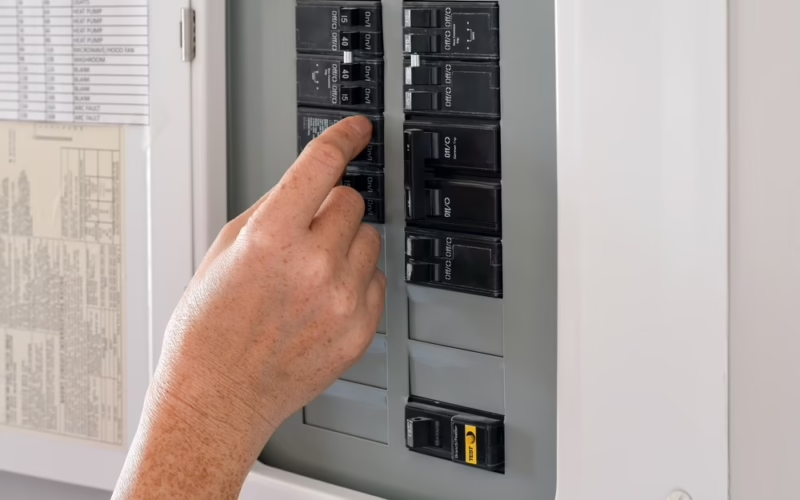
Most residential electrical panels are built to last somewhere between 25 and 40 years, which means anything installed before the mid-1990s is either at the end of its service life or already past it. Electrical panel replacement is one of those projects homeowners postpone until a breaker refuses to reset or an insurance inspector flags the box. The better approach is to understand what your panel is actually doing, how much capacity it has left, and what modern appliances demand from it.
What the Panel Actually Does in Your House
The panel is the single point where utility power enters the home and gets divided into branch circuits. Every breaker inside it is a mechanical safety device designed to trip when current exceeds the rating of the wire it protects, usually 15 or 20 amps on general lighting and receptacle circuits. Breakers wear out, bus bars corrode, and the spring tension that makes a breaker trip reliably degrades over decades of thermal cycling.
That slow decline is invisible from the outside. A 45-year-old panel can look perfectly ordinary while several breakers have lost the ability to trip at their rated current, which defeats the entire purpose of the device. Getting an evaluation from an experienced team like GB Electric can uncover these silent safety hazards before they turn into real emergencies.
Warning Signs That Show Up Before a Failure
Electrical problems rarely announce themselves all at once. These are the symptoms that typically appear first and justify having an electrician open the panel and inspect it:
- Breakers that trip repeatedly on the same circuit, even after you reduce the load plugged into it
- A warm or hot panel cover, which suggests loose connections or an overloaded bus
- Buzzing, crackling or a faint hum coming from inside the enclosure
- A burning or fishy odor near the panel, often melting plastic on a breaker or wire insulation
- Lights that dim when the air conditioner, well pump or dryer cycles on
- Rust, water staining or corrosion on the interior of the cabinet
- Double-tapped breakers, meaning two wires landed on a terminal rated for one
- A fuse box instead of breakers, or a panel with no remaining open slots
Scorch marks around a breaker terminal are the one sign that should never wait. That discoloration is evidence of arcing, and arcing inside an enclosed metal box is how panel fires start.
Panels With Known Defects Still in Service
Several brands installed heavily between the 1950s and 1980s have documented failure problems, and many are still energized in homes today. Federal Pacific Electric Stab-Lok panels are the most widely discussed, with independent testing showing a meaningful percentage of breakers that fail to trip under overload conditions. Zinsco and Challenger panels have their own issues, typically involving breakers that fuse to the bus bar and can no longer disconnect.
Insurance carriers increasingly refuse to write or renew policies on homes with these panels, and home inspectors flag them as a matter of routine. If your label plate reads Federal Pacific, Zinsco, Challenger or Sylvania-Zinsco, replacement by a licensed contractor like GB Electric is the standard recommendation rather than repair.
Modern Households Draw More Power Than 100 Amps Comfortably Supports
A 100-amp service was generous in 1975, when a typical home ran a furnace, a range, a water heater and a handful of lighting circuits. Today the load profile looks very different, and the additions tend to stack up fast:
- Level 2 EV chargers pulling 32 to 48 amps continuously for hours
- Heat pumps and mini-split systems replacing fossil fuel heating
- Induction ranges requiring a dedicated 40 or 50 amp circuit
- Heat pump water heaters and ventless dryers on 30 amp circuits
- Solar inverters and battery storage, which need bus capacity for backfeed
- Hot tubs, workshops and finished basements added years after the original build
Upgrading to a 200-amp service is now the practical default for single-family homes, and 400-amp services show up on larger properties or homes with detached garages and shops. The National Electrical Code also requires AFCI and GFCI protection on far more circuits than it did decades ago, and older panels often cannot accept the breakers that provide it.
What Installation Day Looks Like
A standard replacement takes most crews between six and ten hours, with power off for the majority of that window. The utility disconnects service at the meter or the weatherhead, the old panel comes out, and every branch circuit gets re-landed on the new bus and labeled. An inspection by the local authority follows, sometimes same-day and sometimes within a few business days.
Plan for the outage the way you would plan for a storm: move perishables, charge devices, and arrange a backup if someone in the household depends on medical equipment. Work that involves a service upgrade may require two separate utility visits, one to disconnect and one to reconnect after the inspector signs off.
Hiring an Electrician Who Pulls the Permit
Panel work is permitted work in essentially every jurisdiction, and skipping the permit creates problems that surface years later at closing. A licensed contractor files the application, coordinates the utility disconnect, and schedules the inspection as part of the job. Ask to see the license number, proof of liability insurance and the manufacturer of the panel being installed, since load center quality varies more than most homeowners realize.
The Electrical Safety Foundation International reports that home electrical failures contribute to roughly 46,700 residential fires annually in the United States, and the National Fire Protection Association consistently ranks electrical distribution equipment among the leading causes. Anyone requesting electrical panel replacement in Northampton, PA should expect a reputable contractor like GB Electric to document the existing conditions with photographs before any work begins.
Schedule a Panel Evaluation With GB Electric
If your panel is over 30 years old, shows any of the warning signs above, or carries one of the recalled brand names, a licensed electrician at GB Electric can perform a load calculation and tell you exactly what capacity you have left. Contact GB Electric today to arrange an inspection and receive a clear, written quote before the next breaker refuses to reset.
