
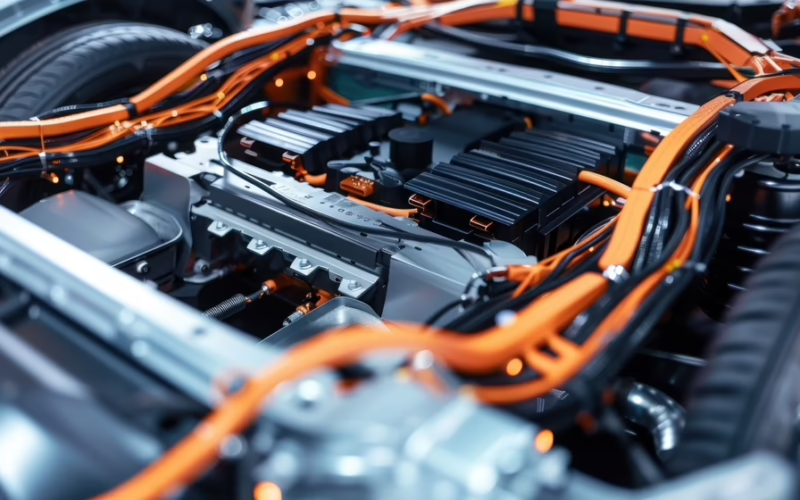
Many drivers wonder about the long-term viability of their electric vehicle as the odometer climbs. Over time, lithium-ion cells lose capacity due to chemical wear, leading owners to investigate a power boost for better range. While electric motors often outlive their energy systems, refreshing the power source is a natural desire for those wanting to keep their vehicles on the road indefinitely. This process has fundamentally changed how we perceive vehicle maintenance and long-term hardware longevity, turning cars into modular machines rather than disposable electronics.
Understanding the Difference Between Replacement and Upgrading
A standard battery replacement restores your vehicle to factory specifications by installing a fresh unit of the same capacity, returning your range to day-one levels. In contrast, an actual upgrade involves installing a system with a significantly larger capacity, though dropping a bigger unit into an older chassis is rarely straightforward or cheap. This path requires a deep dive into the vehicle’s specific architecture to see if it can even accept higher-density cells without altering the center of gravity. To delay these expensive interventions, maintain your battery health and consider having GB Electric inspect your home charging setup to prevent unnecessary cell stress.
Technical and Software Barriers
Every EV chassis has strict physical limits, and engineers design rigid compartments that cannot easily accommodate larger packs without compromising safety or weight distribution. Adding too much weight can negatively impact everything from suspension travel to braking distance, making it more than just a simple plug-and-play operation. Beyond the physical fit, the battery management system (BMS) acts as a digital gatekeeper; since it is tuned to the original kWh pack, different specifications might cause the car to refuse to start.
To support a new pack’s health, look into a professional electrical car charging installation in Northampton to help your home grid handle the demand safely. Proper installation by experts avoids voltage fluctuations that can stress the BMS or shorten the lifespan of your new high-voltage components.
The Reality of a Nissan Leaf Battery Upgrade and Replacement Cost
The Nissan Leaf is a popular candidate for a power swap since its early passive cooling systems caused faster degradation than liquid-cooled competitors. This has sparked a community focused on providing a power source with more kilowatt-hours (kWh) than the original factory unit. In 2026, third-party specialists like Cleevely EV or LKQ Electriq offer refined “translator kits” that allow older 24kWh and 30kWh chassis to safely run modern 40kWh or even 62kWh packs.
| Battery Size | Estimated Hardware Cost | Potential Range Increase |
| 24 kWh (Original) | $3,000 – $5,000 (Used) | Baseline (70-80 miles) |
| 40 kWh (Upgrade) | $7,000 – $9,000 | ~150 miles |
| 62 kWh (Extreme) | $12,000+ | ~220+ miles |
Local Infrastructure and Grid Stability
If you are located in a different region, securing an electric car charger installation in Lancaster can provide the high-voltage stability needed to protect your cells. Professional grounding and dedicated circuits are essential to make sure that your vehicle communicates properly with the grid, preventing “phantom” faults that often plague DIY setups or aging household wiring. Checking that your local infrastructure is up to the task is just as important as the battery chemistry itself.
The Case for Sustainability and the Circular Economy
Upgrading an existing vehicle rather than buying new reduces the demand for raw material mining and vehicle production. Manufacturing a brand-new vehicle has a significant carbon footprint, so extending the life of your current chassis by ten or fifteen years is one of the greenest moves an owner can make. In 2026, the “carbon debt” of a new EV is typically paid off within 10,000 to 11,000 miles, but keeping a perfectly good chassis on the road avoids that initial debt entirely.
These “second-life” batteries can even be repurposed for home energy storage, and GB Electric can help you understand how these systems integrate with your local grid. This circular economy approach turns what would be industrial waste into a high-value asset for your home’s power resilience. By keeping the car on the road and using the old cells to power your lights at night, you maximize the utility of every gram of lithium ever mined for that pack. This transition from “consumer of cars” to “steward of energy assets” is a key pillar of modern sustainable living.
Future Outlook: Solid-State and Beyond
As we move through 2026, the industry is closely watching breakthroughs in semi-solid and all-solid-state batteries. Companies like NIO are already utilizing 150kWh semi-solid packs that offer nearly double the density of traditional lithium-ion. While mass-market all-solid-state retrofits for older cars aren’t yet standard, the rapid fall in cell prices, now hitting record lows near $105/kWh, means that refreshing an old EV is becoming more financially viable than ever.
Independent shops are also getting better at module-level repairs, allowing you to replace only the failing sections of a pack rather than the entire unit. This can drop the repair cost from $15,000 down to roughly $4,000, making it a no-brainer for cars with plenty of life left in the chassis. This democratization of EV repair is crucial for the used car market, as it removes the fear of a “total loss” due to a single bad cell.
Conclusion: Is an Upgrade Worth It?
Before spending thousands, compare your current car to newer models that offer faster charging and fresh warranties, as the cost of a refresh often matches a down payment on a new vehicle. Modern EVs also feature improved thermal management systems that make the cells last much longer than first-generation technology. Real-world data from 2026 shows that modern liquid-cooled packs retain over 80% of their capacity after 100,000 miles, significantly outperforming early air-cooled designs.
However, if your car is mechanically sound, a replacement pack is a sustainable choice, provided your charging infrastructure is ready. Whether you are sticking with your vintage EV or moving into the latest model, a solid electrical foundation is non-negotiable. Our team at GB Electric specializes in optimizing home power systems for the demands of modern transportation. Contact us today to schedule a consultation and bring your home’s electrical capabilities into the future!
