
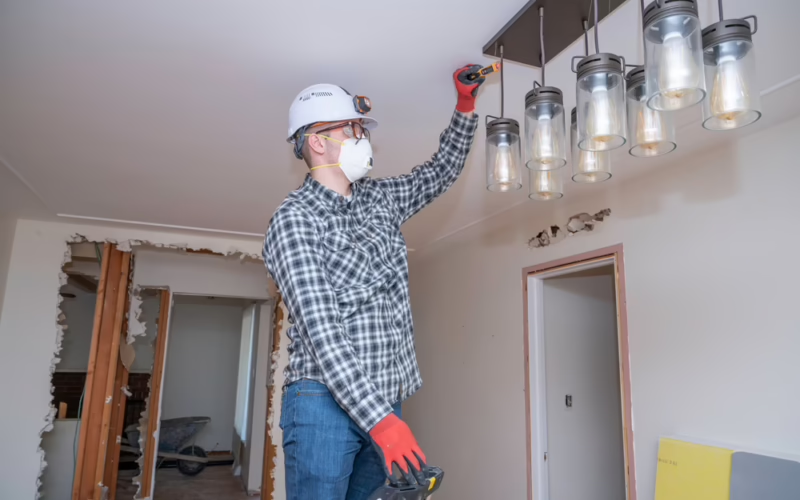
Installing new lighting transforms a room completely and permanently elevates your interior design. You spend hours choosing the perfect chandelier or flush mount to illuminate your ceiling, so knowing how to test a light fixture before installing is essential for any successful home improvement project. The last thing you want is to wire it up, flip the wall switch, and see absolutely nothing happen.
Learning how to test a light fixture before installing saves you from this exact frustration. You bypass the severe physical strain of holding heavy fixtures while balanced on a tall ladder twice. If you are uncomfortable with the technical side, calling a professional for lighting installation in Easton is a great way to verify your setup. We will outline highly practical methods to verify your new lighting works perfectly on the ground.
Why Pre-Installation Testing Matters
Electrical work demands extreme precision and physical effort. Electricians and weekend DIY enthusiasts alike know the immense pain of a faulty product right out of the box. Finding out a fixture is defective after complete assembly wastes your valuable time and physical energy. Whether you are working on a small project or hiring an electrician in Quakertown, identifying defects early is a must.
Manufacturers sometimes ship out units with loose internal connections or faulty sockets that bypass standard quality control. Shipping damage also occurs frequently with fragile lighting components. Testing the unit on your workbench prevents you from mounting a broken product directly to your ceiling. GB Electric recommends this step to avoid the hazards of factory shorts that could trip your breaker or cause sudden sparks.
Preparing Your Workbench
A heavily cluttered environment increases the risk of damaging your fragile new lighting equipment. Clear off a large table or sturdy workbench before opening the manufacturer packaging. Lay down a soft moving blanket or thick towel to protect those delicate metal finishes from accidental scratches.
Gather all your tools and place them neatly within arm’s reach. Good overhead lighting is essential to help you spot tiny defects in the factory wiring insulation. You should also keep the original cardboard box nearby in case you discover an unfixable factory defect that requires a return.
Gathering Essential Electrical Tools
You need specific equipment to properly evaluate a light fixture on your workbench. A digital multimeter is the primary tool for checking internal wiring paths safely. This device measures electrical resistance and confirms the internal circuit is fully complete from end to end.
Essential Tool List:
- Digital Multimeter: To check for continuity and resistance.
- Continuity Tester: A simpler alternative for basic circuit verification.
- Wire Strippers: To expose copper ends for accurate probe contact.
- 120-Volt Testing Pigtail: For performing a live electrical test on the ground.
- Magnetic Tray: To hold tiny screws and hardware securely.
Keep a clean, well-lit workbench available for this entire evaluation to prevent accidents. Testing on a flat surface prevents damage to glass shades or delicate metal arms. Having these tools nearby streamlines the entire evaluation process from start to finish, a practice followed by the pros at GB Electric.
Wiring and Socket Inspection
Before applying any tools, look closely at the physical unit for obvious damage. Start by carefully examining the entire length of the exposed wiring extending from the top mounting canopy. Look for deep cuts, heavy crimps, or missing insulation along the black and white electrical wires.
Next, inspect the internal light socket. The brass metal tab at the bottom of the socket must sit slightly elevated from the base. If that tab is pressed completely flat, the bulb will not make proper electrical contact. GB Electric technicians often find that a simple adjustment to this tab can fix a “dead” fixture.
Checking Electrical Continuity
Electrical continuity testing confirms that electricity can flow freely from the top wire directly to the bottom socket. This test happens with the power completely off, making it safe for beginners. Your multimeter sends a tiny battery current through the wire to verify the internal connection is solid.
| Wire Type | Test Connection Point | Expected Multimeter Result |
| Hot (Black) | Center brass tab of socket | Beep or Zero Ohms |
| Neutral (White) | Threaded metal socket walls | Beep or Zero Ohms |
| Ground (Green/Copper) | Metal fixture frame | Beep or Zero Ohms |
Performing the Test
- Set the Multimeter: Turn the dial to the continuity setting (the sound wave icon). Touch the probes together to verify the meter beeps.
- Test the Hot Path: Place one probe on the stripped black fixture wire and the other on the center brass tab inside the socket.
- Test the Neutral Path: Move the probes to the white wire and the threaded metal cylinder lining the socket.
- Check for Shorts: Touch one probe to the black wire and the other to the white wire. The meter should not beep. If it does, there is a short circuit.
Integrated LED and Multi-Bulb Units
Large dining room chandeliers feature multiple sockets connected to a single central power wire. You must verify that every single socket receives power before hanging the heavy unit. Identify disconnected arms on the ground to avoid disassembling a mounted chandelier later.
Integrated LED lighting relies on computer boards and drivers. You cannot test these using a standard continuity check. The only way to verify an integrated LED fixture is through a live pigtail test, connecting the unit to a temporary plug to supply 120-volt power. If you are wary of live voltage, GB Electric can handle this specialized testing for you.
Troubleshooting and Final Thoughts
If the fixture fails the continuity test, do not attempt to tear it apart. Modifying factory wiring usually voids the manufacturer warranty and creates hidden fire hazards. First, verify your testing equipment functions correctly on a known working item. If the defect is real, pack it back into the box for an immediate replacement.
Verifying your new lighting on the ground is a hallmark of professional work. This simple preventative measure takes less than ten minutes and saves immeasurable time. You now possess the knowledge to evaluate any lighting product before mounting it permanently. Always prioritize personal safety and take your time during the critical testing phase. Contact us today to schedule your professional installation or for expert electrical advice!
