
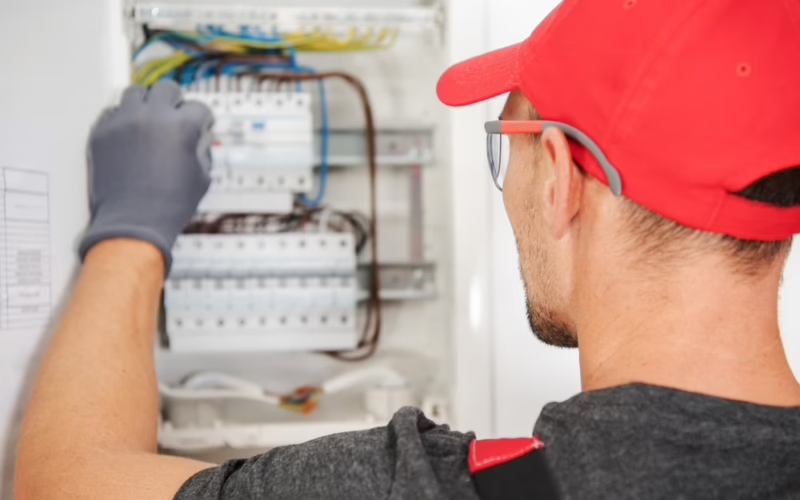
Most licensed electricians have logged somewhere between 8,000 and 10,000 hours of supervised field work and passed a written exam on the National Electrical Code before they are allowed to pull a permit on their own. That training is the real difference between a wired outlet that lasts thirty years and one that quietly overheats behind drywall. While hiring a licensed contractor like GB Electric costs more per hour than a handyman, it remains the cheaper, safer decision over the life of your home.
What a License Actually Certifies
Electrical licensing is not a business registration or a logo someone buys. In most states, a journeyman license requires documented apprenticeship hours under a licensed contractor, plus a proctored exam covering conductor sizing, grounding and bonding, overcurrent protection, and load calculations.
A master electrician sits one tier above that, usually requiring several additional years in the field and a second exam focused on design and code interpretation. Established contractors like GB Electric also carry comprehensive liability insurance and workers’ compensation, keeping an injury on your property from becoming your financial problem.
The code itself changes constantly. NFPA 70, the National Electrical Code, is revised on a three-year cycle, so requirements for arc-fault protection, GFCI coverage, and EV charger circuits look different today than they did in 2017. Licensed electricians take continuing education to stay current with those revisions; unlicensed workers generally do not.
The Failure Modes Behind Amateur Wiring
Bad electrical work rarely announces itself. A loose neutral, an over-torqued lug, or a 14-gauge wire feeding a 20-amp breaker can operate normally for years before heat damage accumulates in a junction box you never open.
According to the National Fire Protection Association, electrical distribution and lighting equipment is involved in roughly 32,000 reported home structure fires each year in the United States, causing hundreds of civilian deaths and well over a billion dollars in direct property damage. Those numbers are dominated by wiring and related equipment, not by appliances failing on their own.
Common defects found during resale inspections include:
- Double-tapped breakers: Two conductors sharing a terminal designed for one.
- Missing junction box covers: Splices left exposed or made outside a box entirely.
- Ungrounded receptacles: Three-prong outlets retrofitted onto two-wire cloth circuits without GFCI or proper grounding.
- Undersized conductors: Thin wiring feeding kitchen, laundry, or HVAC loads.
- Improper panel bonding: Neutrals and grounds tied together in subpanels.
None of those mistakes require malice or even carelessness. They happen because someone followed a video instead of a code book.
Permits and Inspections Protect Your Equity
Homeowners often treat permits as a tax on getting work done. In practice, the permit buys you a second set of trained eyes: a municipal inspector who checks the work against the adopted code edition and signs off in writing.
That paperwork matters at closing. Appraisers and buyers’ inspectors flag unpermitted panel swaps, added circuits, and finished basements wired without inspection, and lenders sometimes require the work be corrected or re-permitted before funding. Retroactive permits are possible, but they usually mean opening walls so an inspector can see what is behind them.
A licensed contractor pulls the permit in their own name and carries responsibility for passing inspection. Local familiarity helps too, since inspection practices and utility procedures differ between jurisdictions; for example, an electrician in Northampton, PA that residents hire repeatedly can usually schedule a service upgrade without the utility coordination delays that catch out-of-area contractors. When a homeowner pulls the permit for a friend doing side work, that liability shifts entirely to the homeowner.
How Insurance Companies Look at It
Standard homeowners policies cover fire damage, but insurers investigate cause and origin on any significant loss. If an investigator traces ignition to a circuit installed without a permit by someone with no license, the carrier has grounds to reduce or deny the claim depending on policy language and state law.
There is a second exposure most people overlook. If an uninsured worker is injured on your property, medical costs and lost wages can land on your homeowners liability coverage, and your carrier may pursue you for the difference. Asking GB Electric or any contractor for a certificate of insurance takes about four minutes and removes that risk.
Jobs Worth Leaving Alone
Swapping a light fixture on a circuit you have confirmed dead is a reasonable homeowner task. Several categories are not, because the failure consequences are severe and the code requirements are detailed:
- Inside the service panel: Breaker additions and main lug work stay dangerous because main lugs stay energized even with the main breaker off.
- Service entrance and meter work: Requires utility coordination and often a licensed contractor by law.
- Aluminum branch wiring repairs: Requires approved connectors and specific antioxidant procedures.
- Grounding electrode and bonding systems: Errors defeat protection you cannot see or test casually.
- Wet or hazardous location circuits: Swimming pools, spas, and some garage or crawlspace areas require specialized knowledge.
The Electrical Safety Foundation International publishes free homeowner guidance on which tasks fall outside the DIY line, and it is worth reading before you buy a roll of Romex.
Verifying a License Before You Hire
Verification is quick and most homeowners skip it. Ask for the license number, then check it against your state or municipal licensing board’s online lookup, which will show status, expiration, and any disciplinary history.
Beyond the license itself, a short screening conversation tells you most of what you need:
- Will you pull the permit, and is the permit fee included in the quote?
- Can you send a current certificate of general liability and workers’ compensation insurance?
- Is the quote flat rate or time and materials, and what triggers a change order?
- What warranty covers labor, and how long does the manufacturer warranty run on parts?
- Who performs the work, a licensed journeyman or an apprentice under supervision?
Work with a team that has an established local track record. A crew that regularly works as an electrician Nazareth, PA that homeowners call for panel work already knows the local inspector, the permit portal, and the typical lead times.
Warning Signs That Warrant a Call Now
Some symptoms can wait for a scheduled appointment, and some cannot. Breakers that trip repeatedly on the same circuit, outlets warm to the touch, a burning or fishy plastic smell near a panel, buzzing from a switch, or lights that dim when the HVAC starts all point to connections or capacity problems that get worse with time.
Panels from certain manufacturers, notably Federal Pacific Stab-Lok and Zinsco, have documented histories of breakers failing to trip under fault conditions. If your home was built between roughly 1950 and 1985 and still has the original panel, having GB Electric evaluate it is money reasonably spent.
Schedule Your Electrical Work With a Licensed Pro
If your panel is original to the house, your breakers keep tripping, or you are planning a project that adds real load, a licensed electrician can evaluate the system and tell you what actually needs attention. Contact GB Electric today to get on the schedule and receive a clear, written quote before any work begins.
