
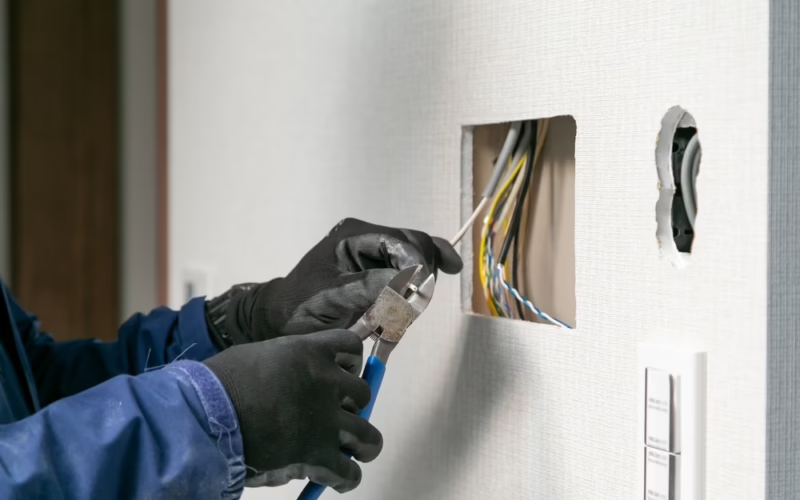
When an electrical issue pops up, whether a tripping breaker, a buzzing light switch, or a dead outlet, it is tempting to think a standard household toolbox will do the trick. However, electrical work requires far more than basic hand tools. Professional electricians rely on specialized, rated equipment designed specifically to prevent electrical shock, accurately measure live currents, and diagnose hidden circuit problems.
At GB Electric, our team uses industry-grade tools every day to diagnose and resolve residential and commercial electrical issues safely. Understanding what is inside a professional’s tool kit helps explain why complex electrical work requires specialized training, calibrated equipment, and strict adherence to safety codes.
Essential Diagnostic and Testing Equipment
The most critical stage of any electrical service is testing. Before touching a single wire, electricians must verify voltage levels, trace circuit paths, and check for hidden faults. A visual inspection rarely tells the whole story, as serious issues like open neutrals or voltage drops occur deep within walls or electrical panels.
Key testing gear includes:
- Non-Contact Voltage Testers: A handheld sensor that detects live voltage through wire insulation without physical contact, providing a vital initial safety check before touching any fixture or terminal.
- Digital Multimeters: Precision meters that read alternating current (AC) voltage, direct current (DC) voltage, resistance, and continuity to pinpoint short circuits, ground faults, or open lines.
- Circuit Breaker Finders: Two-part transmitter and receiver sets that quickly identify which circuit breaker controls a specific wall outlet across a large building, eliminating guesswork at the main panel.
- GFCI Outlet Testers: Compact plug-in devices that display wiring configuration errors (such as reversed polarity or missing grounds) and test ground fault protection trip speeds.
- Clamp Meters: Specialized meters that measure current flow around a live conductor without breaking the circuit, ideal for assessing heavy appliance loads and main service feeds.
Diagnosing complex issues, like hidden junction box faults, loose neutral connections, or overloaded breaker panels, requires interpreting these digital readings accurately. For homeowners dealing with recurring outlet failures or flickering lights, booking professional electrical repairs in Breinigsville guarantees that the root cause is resolved safely.
Insulated Hand Tools Designed for Safety
Regular hand tools with simple rubber or plastic-dipped handles are not designed for electrical work. Standard tools can allow high-voltage currents to jump directly through the handle to the user. Electricians use VDE-certified insulated hand tools tested up to 1,000 volts to shield technicians from electrical arcs, unexpected current feedback, and accidental short circuits while working inside crowded panels.
| Tool Type | Primary Function | Safety Feature |
| Insulated Screwdrivers | Tightening terminal screws and breaker connections | 1,000V rated insulation extending right down to the tip |
| Lineman’s Pliers | Twisting, gripping, pulling, and cutting heavy gauge wire | High-leverage joints with thick protective handle guards |
| Precision Wire Strippers | Removing wire sheathing cleanly without nicking copper | Machined gauge notches to prevent scoring conductive strands |
| Needle-Nose Pliers | Bending precise loops for screw terminals in tight boxes | Slim profile with non-conductive handle sleeves |
| Cable Cutters | Shearing cleanly through large feeder wires and conduit | Curved blades designed to cut without crushing copper strands |
Using uninsulated tools on electrical systems risks severe shock, short-circuiting live terminals, or causing sparks that damage sensitive home electronics.
Calibrated Torque Drivers and Mechanical Fastening Tools
One of the most overlooked aspects of professional electrical work is exact terminal torque. Under National Electrical Code (NEC) Section 110.14(D), electricians are required to use calibrated torque tools whenever numerical torque values are specified by an equipment manufacturer. Hand-tightening breaker lugs or terminal screws based on feel alone is no longer compliant or safe.
- Calibrated Torque Screwdrivers: Used on smaller branch circuit breakers, switch terminals, and outlet connections to make sure that set-screws meet precise inch-pound (in-lb) specifications.
- 3/8-Inch & 1/2-Inch Drive Torque Wrenches: Designed for high-amperage main breaker lugs, panel bus bars, and transformer taps where higher mechanical force is required.
- Insulated Hex/Allen Bit Sockets: Used alongside torque wrenches to securely clamp thick main service feeder cables without damaging individual copper strands.
Proper torque prevents two severe failure modes: under-torquing, which leaves a loose connection that creates high electrical resistance, localized overheating, and eventual fire hazards; and over-torquing, which can strip terminal threads, crack bus bar mountings, or crush wire conductors to the point of structural failure.
Specialized Wire Pulling and Access Gear
Fixing electrical problems often means reaching wires concealed behind drywall, above finished ceilings, or inside tight conduits. Specialized access tools make it possible to run new lines and repair existing paths without opening up unnecessary wall space or causing structural damage.
- Fish Tapes and Wire Rods: Flexible steel, nylon, or fiberglass tapes fed through conduit or hollow wall cavities to pull new conductors into position smoothly.
- Conduit Benders: Handheld lever tools used to bend metallic conduit cleanly at precise angles without kinking or collapsing the inner channel.
- Thermal Imaging Cameras: Infrared cameras that locate loose connections, overloaded breakers, and overheating wires hidden behind closed wall panels before they become fire hazards.
- Wire Stripping and Crimping Systems: Heavy-duty ratcheting tools that seal wire splices and connectors with precise, repeatable pressure to stop loose wires from heating up under load.
If you suspect hidden wiring damage or need system updates, working with a certified electrician in Emmaus gives you access to high-precision equipment that keeps your home’s structural framing and drywall intact.
Advanced Power Quality & Circuit Analyzer Tools
Beyond basic meters, diagnosing intermittent or subtle electrical issues requires specialized analyzer equipment that evaluates power quality over time. These complex tools are essential for identifying issues that don’t trigger an immediate breaker trip but still harm appliances or cause annoying performance glitches.
- Power Quality Analyzers: Data-logging instruments connected to a service panel to measure voltage sags, voltage surges, phase imbalances, and harmonic distortion caused by heavy electronic loads.
- Oscilloscopes: Handheld scopes used to view real-time electrical wave signals, allowing technicians to spot voltage noise, transient spikes, and irregular sine waves affecting sensitive smart home gear or computers.
- Circuit Load & Voltage Drop Testers: Diagnostic tools that place a temporary simulated load (such as 12, 15, or 20 amps) on a branch circuit to calculate percentage drop over long wire runs, confirming whether wire gauge sizing meets code limits.
- Earth Ground Resistance Testers: Specialty meters designed to test the resistance of the grounding electrode system (ground rods and plate systems) to guarantee fault current can path safely into the earth during a utility surge or lighting event.
These advanced tools allow electricians to solve frustrating, intermittent problems, such as smart devices resetting randomly or HVAC motors overheating prematurely, that standard hand tools will simply never catch.
Personal Protective Equipment and Code Compliance
Beyond hand tools and meters, electrical work requires specialized personal protective equipment (PPE). Professional technicians wear arc-rated face shields, flame-resistant clothing, and voltage-rated rubber gloves protected by leather outer sleeves when working on high-capacity panels. This protective layer guards against arc flashes, sudden, high-temperature discharges that can occur when a live circuit shorts out unexpectedly.
Furthermore, commercial-grade equipment must meet strict calibration standards. A meter that reads incorrectly by even a small percentage can lead to misdiagnosed faults, overloaded circuits, or undetected live wires.
Why Professional Equipment Matters
Having the right tools is only half the battle; knowing how to calibrate and use them correctly according to the National Electrical Code (NEC) is what protects your property from fire hazards. A misplaced tester lead, incorrect wire gauge selection, or loose terminal torque can lead to serious electrical damage over time.
At GB Electric, our technicians come fully equipped with tested, code-compliant tools and diagnostic equipment to handle everything from routine panel maintenance to emergency troubleshooting. Contact our team today to schedule an inspection or repair with our experienced technicians.
